PPS+ vs PPLNS: Which Payout Method Fits Your Mining Setup
PPS+ pays you per valid share against current difficulty and hands pool-luck risk to the pool; PPLNS pays only when the pool finds blocks, splits rewards across the last five difficulty rounds, and leaves that variance with you. The fee difference is real but smaller than most miners assume: on 4 PH/s producing $151.97 of gross daily income, the listed 4% rate on the block-reward component versus a listed 2% combined rate is about $3.04 a day. The decision usually turns on cash flow, not on the fee.

Key takeaways
- PPS+ is not a flat haircut. The listed rate is 4% on the PPS-settled block-reward component and 2% on the transaction-fee component, which is why a 4% headline is not 4% of your income.
- Settlement cadence differs by design: PPS+ pays hourly against current difficulty, while PPLNS distributes after a block reaches 6 confirmations, weighted by hashrate over the last 5 difficulty rounds.
- Expected value is set by network share, not by method, so the real question is which variance you can fund: a 4 PH/s rig producing $151.97 gross per day keeps about $30.69 after 20 J/TH power at $0.06/kWh under the 4% route.
- Switching to PPLNS on the same rig would free roughly $3 a day — around $91 a month — in exchange for income that arrives in lumps instead of on the hour.
Context in 2026
Bitcoin's network now runs at a difficulty of 132.76 T and roughly 1,003 EH/s of hashrate, distributing 450 BTC of daily subsidy plus transaction fees. Against those numbers, a single machine's expected output is tiny and its variance is enormous: with a per-terahash rate near 0.0000004486 BTC per day, the pool you pick decides whether that income lands every hour or waits for a block.
The next difficulty adjustment is estimated at −2.12%, which would nudge per-terahash revenue up slightly if it lands as forecast. That matters for method choice in one specific way: a lower difficulty produces more blocks per hour, which shortens the intervals in a PPLNS distribution and makes it look smoother than it is during a dry stretch.
The two variables that matter
The first variable is who carries pool-luck and orphan risk. Under PPS+, the pool pays a theoretical amount for every valid share whether or not a block is found, and absorbs the consequences of a bad streak or an orphaned block. That service is not free, which is why the listed fee on the block-reward component is the higher of the two rates. Under PPLNS, you are paid only out of blocks the pool actually finds, weighted by your share of pool hashrate over the last five difficulty rounds, so a bad streak is your bad streak.
The second variable is the fee attached to each payout component. The distinction matters because a payout is not one bucket of money: the block reward and the transaction fees inside a block are settled by different logic, and a mid-sentence summary that turns it into "6%" is wrong in both directions. The ViaBTC Mining Pool publishes both methods with the components spelled out, and its fee breakdown exists precisely because the flattened version keeps circulating.[1]
Everything else about the two methods is downstream of those two variables: who takes the risk, and which component each rate touches.
Numbers from a real rig
Here is a 4 PH/s rig built from 20 J/TH hardware. Hashrate of 4,000 TH/s at 20 joules per terahash is 80 kW of continuous draw — 1,920 kWh a day, or $115.20 at a power price of $0.06/kWh. Gross income at today's difficulty is $151.97 a day.
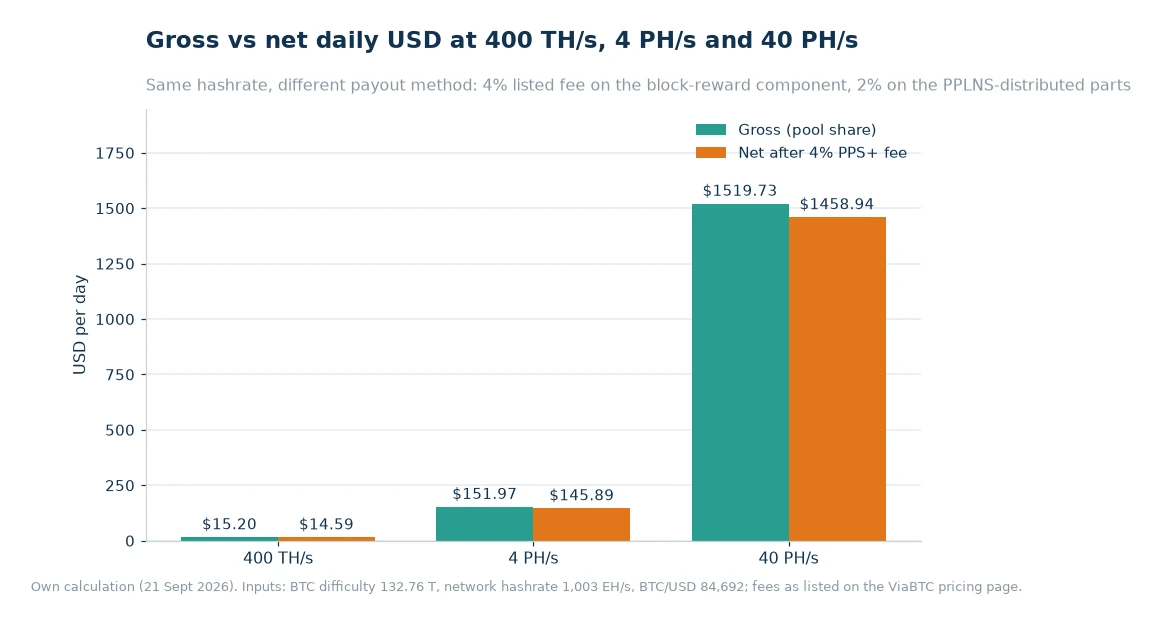
Applying the listed 4% rate to the block-reward component leaves $145.89; applying a listed 2% combined rate to the same gross leaves $148.93. The gap is $3.04 a day, roughly $91 a month on this rig, and it is the entire financial case for one method over the other.[2]
| Hashrate | Gross per day | At the listed 4% block-reward rate | At the listed 2% combined rate | 30-day difference |
|---|---|---|---|---|
| 400 TH/s | $15.20 | $14.59 | $14.90 | $9.12 |
| 4 PH/s | $151.97 | $145.89 | $148.93 | $91.18 |
| 40 PH/s | $1,519.73 | $1,458.94 | $1,489.34 | $911.84 |
Now subtract power. The 4 PH/s rig spends $115.20 a day on electricity, so it keeps about $30.69 under the higher-rate route and $33.73 under the lower one — a margin of roughly 20% of gross either way. The choice of payout method moves that margin by about 10% relative, which is worth having but is not the difference between a viable farm and an unviable one.
What hourly settlement is worth in practice
Timing changes behaviour as much as it changes totals. Under PPS+ at current difficulty, 1 PH/s settles about 0.0000187 BTC per hour — near $1.58 — so a farm's electricity invoice can be paid from payouts that arrived during the same day they were billed. Under PPLNS, income follows the pool's block discoveries, and a run of unlucky hours produces a cash-flow dip that has nothing to do with your machines.
For operators who also hold balances across several coins, the wallet side of that equation is part of the payout method decision. Earnings that land directly in a multi-currency wallet can be converted without an exchange withdrawal, which removes a step that often costs more in fees and settlement time than the two-point fee difference above.
Decision guide
- Pick PPS+ when cash flow is tight. A small farm paying fixed power bills, a host with monthly invoices, or an operation funded partly by debt all benefit from hourly settlement against current difficulty. You accept the higher listed rate on the block-reward component as the price of that predictability.
- Pick PPLNS when you can fund a dry spell. Larger operators with reserves and low fixed costs are the natural fits, because the lower combined rate compounds and variance is absorbed by the balance sheet rather than by a payment schedule.
- Check both against your own model. Run your hashrate, price, difficulty and power cost through a profit calculator twice, once at each listed rate, and compare the monthly figures with the interest cost of the working capital you would need to bridge PPLNS gaps.
- Re-test after each difficulty retarget. A −2.12% adjustment lifts per-terahash revenue and shortens block intervals; a sharp upward adjustment does the opposite.
Frequently asked questions
How often should a miner check pool statistics?
Weekly is enough for cash flow, daily if you are reconciling worker uptime or chasing a hashrate fault.
Does the payout method change my average income?
It changes the variance and the fee, not the underlying expected value: your share of network hashrate still sets the ceiling.
Can I switch between PPS+ and PPLNS later?
Both are account settings a miner chooses, and neither requires moving hardware. Test the alternative for a full difficulty round before judging it, because a single distribution window says more about luck than about the method.
Choose the variance you can pay for
Decide in this order: work out the monthly fee difference for your own hashrate, then work out how many days of missing income your cash reserves can cover. If the answer is fewer days than a plausible dry spell, take PPS+ and its hourly settlement. If the reserve is deep, take the lower rate and let the variance ride.
Either way, write the numbers down before you switch and check the first month's realised payout against the calculation. That comparison — not the headline rate — is what makes the next decision easy.
Data and sources: ViaBTC pricing page and fee breakdown[1][2], with network difficulty read from public chain data on 21 September 2026. All earnings figures are own calculations from difficulty 132.76 T, network hashrate 1,003 EH/s and BTC/USD 84,692 and will shift as those inputs change.