How OEM Helps Independent Perfumers Reach the Shelf
Independent perfumers rarely fail because the scent is wrong. They stall at the point where a formula has to become a filled, labelled, compliant, shippable unit, because that work needs equipment, documentation and materials bought in quantities a studio never uses. OEM exists to absorb that layer. The creator keeps the creative decisions, and the factory takes on everything that has to happen at volume.
Key takeaways
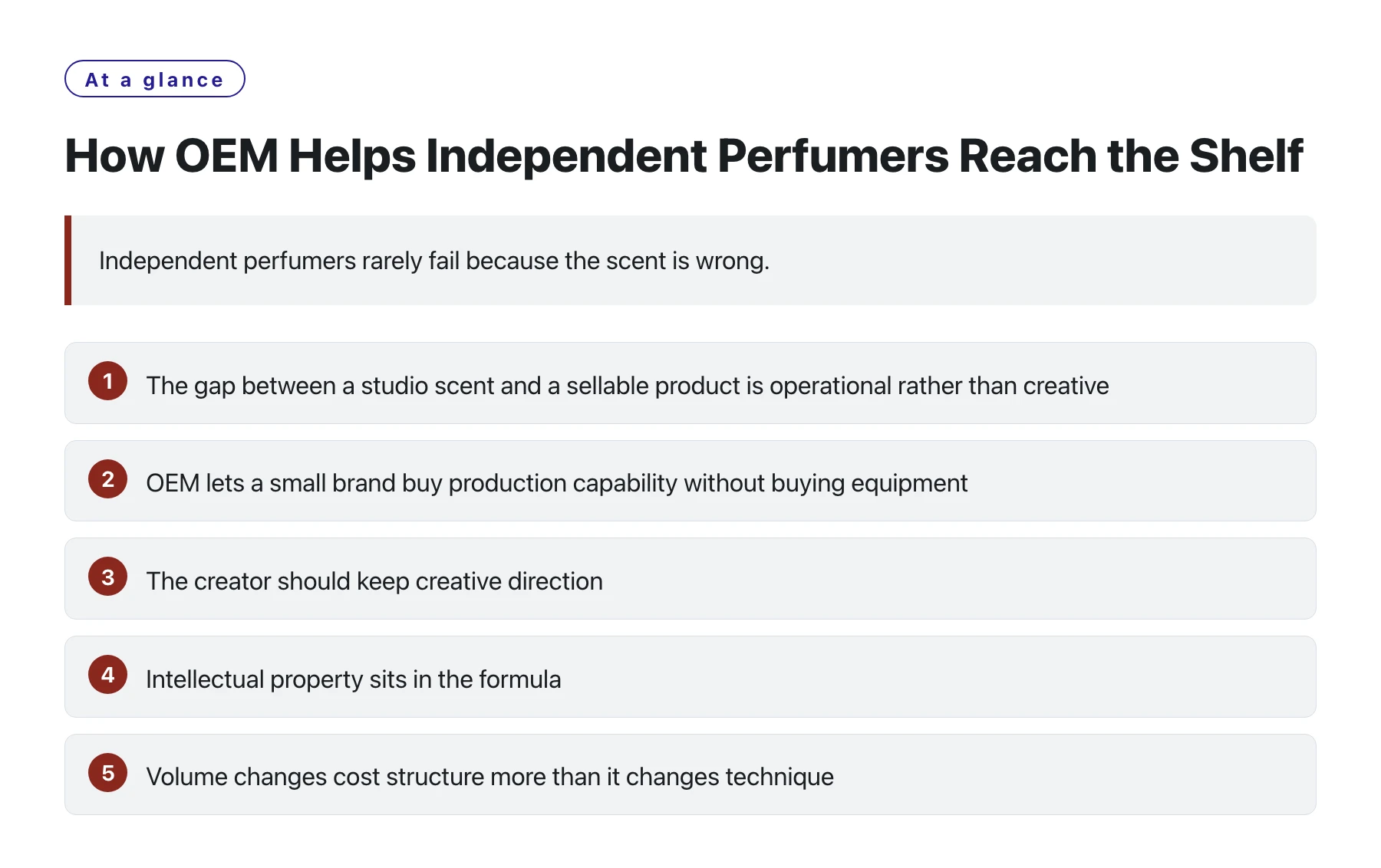
- The gap between a studio scent and a sellable product is operational rather than creative, and it is where most independent projects lose momentum.
- OEM lets a small brand buy production capability without buying equipment, premises or a materials inventory it cannot use.
- The creator should keep creative direction, quality standards and the brand narrative, because those are the assets that make the product distinct.
- Intellectual property sits in the formula, the brand name and the pack design, and each one needs its own protection decision.
- Volume changes cost structure more than it changes technique, so unit economics should be modelled before the first order rather than after it.
Every independent perfumer eventually reaches the same moment. The scent is good, a handful of people have bought it, and the next step requires a thousand units rather than ten. That step is not a bigger version of the studio; it is a different kind of work.
Buying alcohol in industrial quantities, handling flammable liquids on a licensed site, printing compliant labels, keeping batch records and warehousing finished goods are all separate capabilities. Assembling them independently is possible, and for most small brands it is an unnecessary detour.
This article looks at what OEM actually absorbs, what the perfumer must keep doing, and how to plan the transition without losing control of the creative side.
The gap between a formula and a product
In a studio the constraints are aesthetic. At production scale the constraints become logistical: minimum quantities on materials, filling tolerances, label accuracy and the paperwork that has to exist before goods can move across a border.
Understanding which side of that line each task falls on is what makes the OEM conversation productive, because it clarifies what is being bought.
What a studio cannot do at volume
Small-scale production works by handling materials by hand, decanting from small containers and filling one bottle at a time. Industrial filling works the other way around: it requires bulk materials, sealed transfer, in-process checks and a filling line that can be cleaned between products.
Regulatory documentation follows the same pattern. A studio can describe what is in a bottle; a manufacturer has to produce the declarations, safety information and records that a distributor or a customs officer will ask for.
What the brand should keep in-house
Creative direction, the quality standard the product is judged against, and the reason anyone buys it, are the parts that should not be delegated. A factory can produce a scent, but it cannot decide what the brand stands for.
Approving samples, writing the brief and holding the reference standard are small tasks that keep creative control intact. Handing them over is what turns a brand into a supplier arrangement with a logo attached.
Where the money actually goes
The compound is normally the most expensive input, followed by the glass, the closure, and the labour of filling and packing. Development, artwork and documentation are one-off costs that feel large at low volumes and shrink quickly as the order grows.
That is the single most useful thing to understand about scaling: the technique does not change much between a small run and a large one, but the cost per unit changes a great deal.
What changes when a studio scent becomes a product
| Workstream | In the studio | At production scale | What OEM changes |
|---|---|---|---|
| Materials | Small bottles from specialist suppliers | Bulk quantities with lead times and storage needs | Purchasing power and warehouse space |
| Filling | Hand-filled, one unit at a time | Line filling with weight and volume checks | Equipment, cleaning routines and yield control |
| Documentation | Descriptions of what is in the bottle | Declarations, safety data and market-specific records | Format knowledge and template paperwork |
| Packaging | Off-the-shelf components | Custom moulds, decoration and carton assembly | Supplier network and artwork handling |
| Repeatability | Judged by nose and memory | Judged against a retained reference sample | Stored standards and batch comparison |
The last row is the one independent brands underestimate. A scent that is reproduced from memory drifts, and drift is invisible until a customer compares two bottles bought a year apart. A retained reference turns that slow problem into a routine check.
The mistake that hurts most is signing away the formula without understanding it. A small brand that lets a supplier own the compound and licence it back may find that the arrangement is perfectly workable, right up to the moment it wants to change manufacturer or sell the business. Read the ownership clause as carefully as the price, ask what happens if you leave, and keep your own copy of the approved reference. Nothing in the creative work needs to be surrendered in exchange for production capacity. A manufacturer such as Xuelei can be asked these questions directly, and the answers should take minutes rather than a legal review.
A sensible path from studio to first order
- Write the brief as if a stranger had to follow itDescribe the character, the wear target, the format, the market and the price ceiling, so the project does not depend on your presence in the room.
- Decide what you will not compromise onChoose the two or three qualities that define the brand, and treat everything else as negotiable during development.
- Ask for the ownership position in writingClarify who holds the formula, whether it is exclusive to you, and what documentation you receive if you move production.
- Run one small production-scale batchConfirm that the formula behaves outside the laboratory before committing to packaging quantities and a launch date.
- Model the unit cost at two volumesAsk for pricing at your first order and at a larger one, so you can see how much of the cost is fixed and how much is material.
Protecting the creative side while scaling the rest
Scaling is mostly administration, and administration is where creative businesses get careless. Three areas are worth deliberate attention before the first purchase order.
None of them requires legal training to think about; they require only that the questions are asked early, while there is still room to change the answer.
Intellectual property sits in three places
A fragrance business usually holds three different kinds of asset: the formula, the brand name, and the appearance of the bottle or carton. International bodies such as WIPO set out how confidential information and registered designs are treated across borders, which is a useful starting point when deciding what to register and what to keep as a trade secret [1].
The practical question is which of the three would hurt most to lose, and whether the arrangement with the manufacturer protects it. A formula can be protected by secrecy and a contract; a name and a distinctive pack usually need registration.
Trend research is context, not a brief
Market research publishers such as Mintel publish press summaries of consumer trends, and reading them is a fast way to see how independent and niche brands are being discussed by buyers and retailers [2]. What that material cannot do is tell you what your brand should smell like.
Use it to check that your direction is legible to a buyer and to time a launch, then write the brief from your own creative position.
The industry ecosystem is wider than factories
Perfumery education and community organisations, including bodies such as The Fragrance Foundation, exist alongside the manufacturing side of the industry and are where many independent perfumers first learn how products are presented to buyers [3]. On the regulatory side, associations such as Cosmetics Europe describe the framework that finished products have to fit into [4], which is worth understanding before a launch rather than during one.
For a stage-by-stage view of how a small studio becomes a shippable product, see how OEM helps independent perfumers. The short version is that the creative work stays yours and the operational layer does not have to be.
Sources
- WIPO — World Intellectual Property Organization —— The UN agency for intellectual property; resources on industrial design and patent protection relevant to product and packaging design.
- Mintel Press Centre —— Mintel's press releases on consumer and beauty market research, including fragrance and personal care trend reporting.
- The Fragrance Foundation —— A non-profit organisation for the fragrance industry, running perfumery education programmes and industry recognition.
- Cosmetics Europe —— The European trade association for the cosmetics and personal care industry, publishing guidance, positions and market information.
Frequently asked questions
Can an independent perfumer keep the formula when using OEM?
Yes, if the contract says so. Ownership is a commercial term rather than a technical one, and many small brands hold their formula while the manufacturer produces it under licence. Ask for the position in writing before development begins, and keep your own retained reference sample.
How much does a small brand need to order to work with a factory?
It depends on the factory, the components and the materials involved, because minimums are usually driven by packaging and raw material purchasing rather than by the filling line. Ask what is driving the number and whether a different bottle or a stock component would lower it.
What should an independent brand never outsource?
Creative direction, the quality standard and the brand narrative. A factory can make a scent to a specification, but it cannot decide what the brand means. Approving samples and holding the retained reference are small tasks that keep those decisions in your hands.
Is OEM only useful for large orders?
No, though the cost structure favours volume. Development and documentation are largely fixed costs, so the per-unit figure falls as the order grows. A first order is often about establishing the formula and the packaging correctly rather than achieving the lowest possible price.
How do I protect my brand when a factory makes my product?
Separate the three assets. Keep the formula confidential and covered by an ownership clause, register the brand name where you sell, and treat a distinctive bottle or carton as a design asset. Confirm in writing what happens to each one if the relationship ends.