Category Terms Explained: AI Porn Chat, Porn Chat AI, NSFW AI
Three labels circulate for overlapping things, and the confusion is not harmless: it changes what a reader expects to find after a click. A quick map, with the platform's own usage as the guide — its page title reads AI Porn Chat, its FAQ answers a question about Porn Chat AI, and its character lists sit under the wider NSFW AI umbrella.

Key takeaways
- AI Porn Chat and Porn Chat AI are the same category under two word orders; the platform's own page uses both.
- NSFW AI is the umbrella term, used for character collections and trends pages rather than for sessions.
- Sex AI companions and character AI describe who you talk to, not what the conversation is.
- The words carry no numbers. Fit has to come from ratios — 0.029%, 0.026% and 0.015% on the three leading cards — not from vocabulary.
Three labels, one shelf
Start with the pair people trip over most. AI Porn Chat and Porn Chat AI differ only in word order, and the platform uses both on a single page: one in the title and the other in the FAQ. Nothing distinguishes them in function, and no reader needs to choose between them.
NSFW AI sits one level up. It is the umbrella label used for collections rather than for sessions, which is why it appears in the shape of a trends list — the platform's version is titled 20 Best NSFW AI Characters — and why the cards under it carry tags, creator credits and counters.
The third family of terms describes participants rather than pages. Sex AI companions is the product's own phrase for the characters themselves, and character AI is the generic version of the same idea. A session happens with a character; a catalogue is described as NSFW; the page you land on is usually labelled in the porn-chat family.
| Term | Where it appears | What it means | What it does not mean |
|---|---|---|---|
| AI Porn Chat | The page title on the platform's own product page | A category label for the interactive text product | A description of a media format |
| Porn Chat AI | The FAQ on the same page | The same category, word order reversed | A second, different product |
| NSFW AI | Trends and character collections | An umbrella term for adult character catalogues | A guarantee about any individual card |
| Sex AI companions | Product descriptions | The characters a reader talks to | A claim about real people or recordings |
| Character AI | General usage | Interactive text characters in the abstract | A specific platform or brand |
| AI sexting | Product and FAQ wording | A text-based session type | Anything filmed or recorded |
Why the vocabulary confuses rather than clarifies
Two of these terms describe a page and one describes a catalogue, and readers routinely use all three to describe a session. That mismatch produces predictable mistakes: expecting a catalogue label to predict how a single character behaves, or judging a character by the word on the page that led to it.
There is a useful rule of thumb. If a phrase can appear in a page title, it is a category label. If it can appear in a list heading with a number in front of it, it is an umbrella term. If it names someone you talk to, it describes a participant. Sorting a phrase into one of those three buckets removes most of the ambiguity in a paragraph about this subject.
One final confusion is worth naming, because it wastes time in search boxes. These phrases are not ranked. A narrower label is not a more precise search and a broader one is not a better guide; they overlap, and the cards are the same either way.
The labels also carry no information about quality. They are search vocabulary, and search vocabulary is designed to be broad. Everything a reader wants to know about a specific card lives in its tags, its setup text and its counters, not in the phrase that led there.
Worked example: labels say scope, ratios say fit
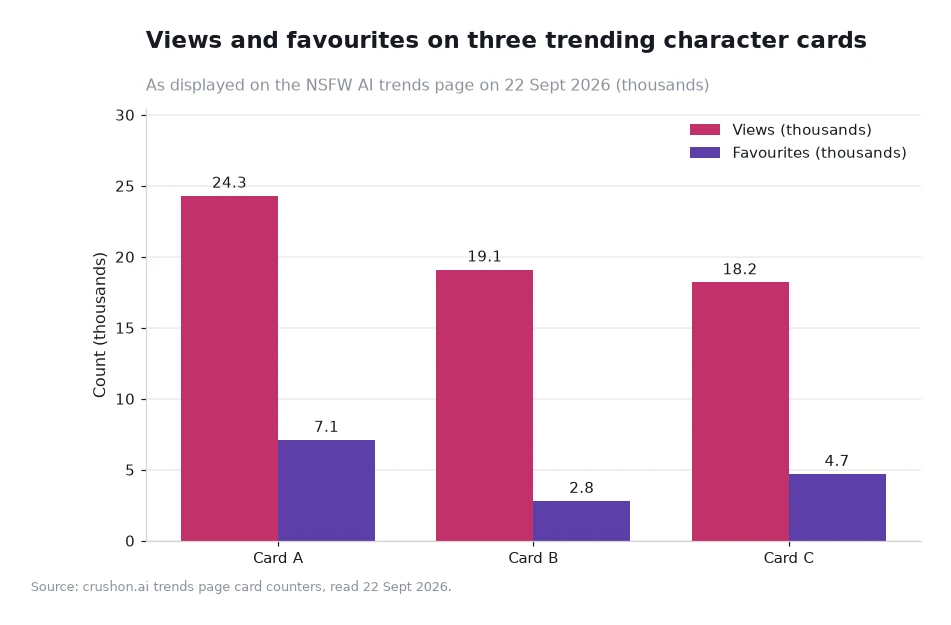
Take the three leading cards on a trends list and pretend their positions are labels. The first shows 24.3M views and 7.1K favourites, which divides to 0.029%. The second shows 19.1M and 2.8K, or 0.015%. The third shows 18.2M and 4.7K, or 0.026%.
If the ordering were a guide to fit, the numbers would agree with it. They do not. The third card has roughly a third fewer views than the first — 18.2M against 24.3M — while its favourites total is about 51% smaller, 4.7K against 7.1K, so the gap in saving is wider than the gap in reach.
That is the whole argument for reading vocabulary as scope and arithmetic as fit. A label tells you which part of a catalogue you are in. Only the division tells you whether the audience kept what it saw.
Using the map in practice
The practical version takes one sentence. Use the umbrella term when you are browsing a catalogue, the porn-chat phrase when you mean the product page, and the companion phrase when you mean the character. Then stop reading labels and start reading cards.
The porn ai page is the reference point for the first two, since it is where the platform uses AI Porn Chat and Porn Chat AI within a few lines of each other. Its three stated features — customizable characters, privacy and discretion, and responses that recall earlier interactions — are the parts of the description that survive translation into any of the labels.
Crushon's other pages keep the map tidy. The 2257 compliance statement confirms that the content is AI-generated text and depicts no real person, which is a boundary no term in this vocabulary should be stretched past, and the character search page shows the same tags and filters in a browsing view rather than a list view.
One habit is worth carrying away from the map. When a phrase in this category feels ambiguous, the quickest resolution is to check whether the platform itself uses it on a page — if it does not, the phrase is probably borrowed from somewhere else and should not be treated as a description of anything specific.
Frequently asked questions
Are AI Porn Chat and Porn Chat AI different things?
No. They are the same category with the words in a different order, and the platform's own page uses both — one in its title, the other in its FAQ.
Where does NSFW AI fit?
Above both. It is the umbrella term for adult character catalogues, which is why it appears in list headings rather than in descriptions of a single session.
Do these terms tell me anything about a character?
Only about scope. For fit, read the tags and setup text, and compare counters as ratios — 0.029% against 0.015% says more than any label does.
Learn the map once, then ignore it
Five minutes spent sorting the vocabulary is enough for good. After that, the useful reading is on the cards: the setup, the tags, the creator credit and the division of two counters. Words get you to the right shelf; only the numbers tell you what people kept once they were there.
Data and sources: the page title, FAQ and product terms published on CrushOn.AI[1], read 22 Sept 2026. The ratio comparisons are arithmetic on the card counters displayed that day. For an adult readership of 18 or more.