Are EVs Cheaper to Run Than Petrol in Australia?
On energy, almost always, and the margin is large enough to survive a lot of bad assumptions. On everything else, it depends on your insurance, your tyres and how you charge. This article separates the published terms from the illustrative arithmetic, so you can see which lines are facts and which are mine.

Key takeaways
- Published: servicing every 12 months or 20,000 km, whichever comes first.
- Published: 7-year whole-vehicle warranty, 8 years or 160,000 km on key parts, 7 years of roadside assistance.
- Illustrative: energy at 18 kWh per 100 km and $0.30 per kWh equals $5.40 per 100 km, against $15.20 for 8.0 L at $1.90 per litre.
- Charging time is part of the cost of ownership, and a 10-80% stop is published at 12 minutes.
The four lines in any honest comparison
Energy, servicing, registration and insurance, plus tyres whenever they wear out. Registration is a state charge and insurance is a market quote, so neither comes from the car maker, and a comparison that ignores them is not comparing ownership at all. What the manufacturer publishes is the servicing interval and the warranty terms, and once those are separated from your own estimates the argument gets much clearer. Anyone telling you that comparing electric cars with petrol cars is a single sum is selling something.
Energy: the line where the gap lives
Assume 18 kWh per 100 km for the electric figure and $0.30 per kWh on a home tariff. That is 18 x 0.30 = $5.40 per 100 km. Assume 8.0 L per 100 km at $1.90 per litre for petrol, which is 8.0 x 1.90 = $15.20 per 100 km. Both sets of numbers are illustrative, and both can be moved: a cheaper overnight tariff lowers the first, a thirsty car in traffic raises the second. Even so, the gap is 15.20 - 5.40 = $9.80 per 100 km, which is a difference of 15.20 / 5.40 = 2.8 times before any of the other lines are counted.
Servicing: published intervals instead of guesses
The published schedule is every 12 months or 20,000 km, whichever comes first, through an XPENG Authorised Dealer, and the site does not publish service prices. That is the honest position: the cadence is known, the invoice is not, because it depends on what the visit finds and what your dealer charges. What the published terms do settle is the warranty side, which is where the real ownership risk sits. Whole-vehicle cover runs 7 years unlimited kilometres for private use, key parts including the traction battery run 8 years or 160,000 km with a minimum of 70% of original capacity promised during that period, paint is 5 years unlimited kilometres, anti-corrosion 7 years unlimited kilometres, and roadside assistance runs 7 years from first registration with 24/7 coverage across most of Australia.
What gets left out of the pitch
Tyres wear faster on a heavier car, and an electric vehicle is heavier than its petrol counterpart of similar size. Insurance quotes move with repair costs and postcode rather than with fuel type, so an EV quote can land either side of a petrol one. And public charging is not priced like a home tariff, so a driver with no off-street parking pays a very different rate per kilometre than one with a wallbox in a garage. Treat those three as questions for your own spreadsheet, not as arguments to be won.
Charging time is part of the running cost
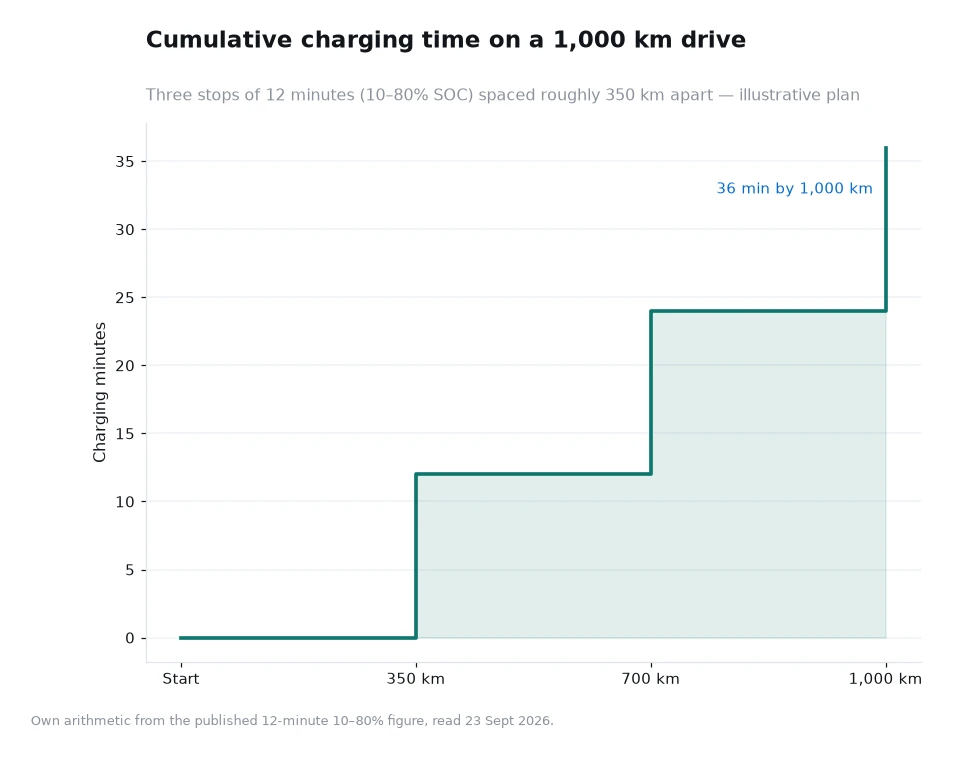
Time is the cost nobody puts in a comparison table. A published 10-80% charge in 12 minutes means the electric side of a long trip costs minutes rather than hours, and planning around three stops of 12 minutes gives you the same 36-minute total whether you spread the stops over 1,000 km or take them closer together. On a day where the alternative is 10 hours of driving, 36 minutes is not the deciding factor in a purchase.
| Item | Published term |
|---|---|
| Scheduled servicing | Every 12 months or 20,000 km, whichever comes first |
| Whole vehicle warranty | 7 years / unlimited km |
| Key parts, including traction battery | 8 years / 160,000 km |
| Roadside assistance | 7 years from first registration |
Servicing: the cadence is published, the invoice is yours
The published schedule for the New G6 is every 12 months or 20,000 km, whichever comes first, carried out through an XPENG Authorised Dealer. What that visit costs depends on what it finds, and the manufacturer does not publish service prices, which is why a comparison built on invented service figures is worth less than one built on the interval alone. The predictable part is the count: at 15,000 km a year the calendar governs and you book one visit annually; at 25,000 km a year the distance trigger arrives first, so you book sooner. Every service inside the term also stays inside the published warranty, which is the part of ownership a petrol comparison rarely bothers to mention.
The published terms that survive the comparison
Whatever your assumptions do to the energy figures, some ownership numbers are fixed. Whole-vehicle warranty runs 7 years unlimited kilometres for private use. Key parts, including the traction battery, battery management system, drive motor and intelligent power unit, run 8 years or 160,000 km, whichever comes first, with a minimum of 70% of original battery capacity provided during that period and gradual capacity loss described as normal for traction batteries. Paint is covered for 5 years unlimited kilometres and anti-corrosion for 7 years unlimited kilometres. Roadside assistance runs 7 years from first registration with 24/7 coverage across the majority of Australia. Those are the lines that do not move when the petrol price does, and they are the ones to quote back when someone insists an electric car is a gamble.
Worked example: one year, 15,000 km, two ways
Illustrative arithmetic with the assumptions stated, and not manufacturer data. Assume 15,000 km a year, 18 kWh per 100 km at $0.30 per kWh for the electric figure, and 8.0 L per 100 km at $1.90 per litre for petrol. Electric: 15,000 / 100 = 150 blocks of 100 km, so 150 x 18 = 2,700 kWh, and 2,700 x 0.30 = $810 for the year, or 810 / 12 = $67.50 a month. Petrol: 150 x 15.20 = $2,280 for the year, or 2,280 / 12 = $190 a month. The annual difference is 2,280 - 810 = $1,470. Charging time for the same distance is harder to state because nobody drives 15,000 km in a straight line, but the 1,000 km plan in the chart below is a fair illustration: three stops of 12 minutes, so 3 x 12 = 36 minutes of charging, plotted cumulatively as 0, 12, 24 and 36 minutes at the start, 350 km, 700 km and 1,000 km.
Frequently asked questions
Is an EV really cheaper to run than a petrol car in Australia?
Energy is where the gap is largest, and servicing intervals are published rather than estimated. Whether the total is cheaper depends on your tariff, your annual distance, your insurance quote and your tyres. The figures in this article are illustrative assumptions rather than manufacturer data, so rerun them with your own numbers.
What service interval does the manufacturer publish?
Every 12 months or 20,000 km, whichever comes first, with servicing recommended through an XPENG Authorised Dealer. The same published schedule applies whether the car is driven hard or gently, and the owner's handbook and warranty manual hold the detail.
Run the numbers on your own driving
Start with last year's odometer reading, then apply your own tariff and a consumption figure you are willing to defend. Add one scheduled service inside the published 12-month interval, plus registration and an insurance quote, and you have a defensible annual number. Repeat it for the petrol car you are leaving and the comparison stops being a debate. The warranty and service pages carry the published terms, and the Australian range overview shows which models those terms apply to.
Servicing intervals and warranty terms in this article are as published on the manufacturer's Australian website and read on 23 Sept 2026. Every dollar figure is my own illustrative calculation based on the assumptions stated, not manufacturer data; WLTP range and consumption depend on conditions. [1]